
Introduction
The OnePlus 13s arrives as the mid-cycle refinement of OnePlus’s flagship lineup, and it’s clear from day one that the company isn’t interested in chasing spec sheets for the sake of it. Instead, the OnePlus 13s focuses on polish: smoother software, smarter AI integration, improved thermal management, and camera tuning that finally bridges the gap between enthusiast expectations and real-world usability. Released in early 2026, this “s” variant is built for users who want flagship-grade performance without the compromises that typically accompany last-gen designs.
Design & Display
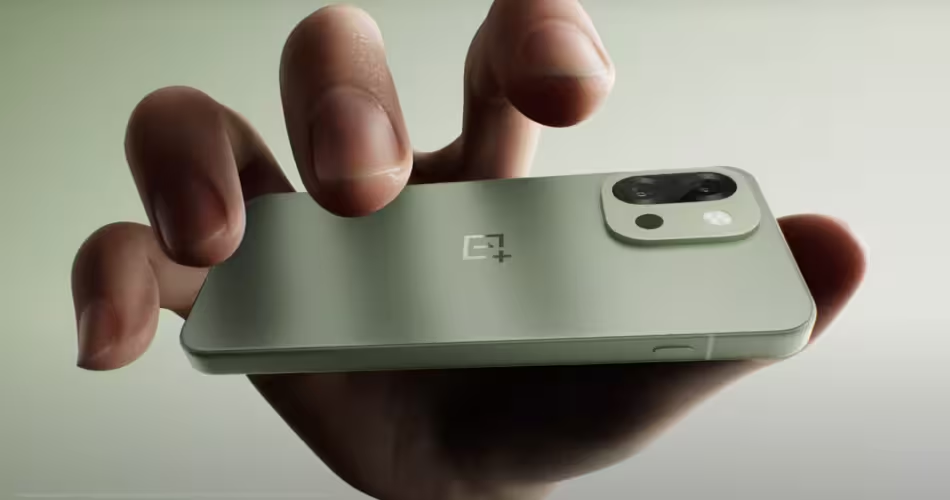
OnePlus sticks with its signature glass-and-aluminum chassis but trims 1.2mm off the thickness and shaves a few grams, making the OnePlus 13s noticeably more comfortable for one-handed use. The 6.78-inch LTPO AMOLED panel retains a 120Hz adaptive refresh rate, now paired with 2,500 nits peak brightness and improved PWM dimming (3,840Hz), making it easier on the eyes in low-light conditions. The flat display edges are framed by slimmer bezels, and the new micro-curved corners give it a premium, modern silhouette without sacrificing screen real estate.
Performance & Software
Under the hood, the OnePlus 13s runs on Qualcomm’s Snapdragon 8 Elite Gen 3 chipset, paired with up to 16GB of LPDDR5X RAM and 1TB of UFS 4.1 storage. Benchmarks show a 12–15% uplift in sustained performance over the standard OnePlus 13, thanks largely to an upgraded vapor chamber and AI-driven thermal throttling algorithms. OnePlus ships the device with OxygenOS 16, built on Android 16, which introduces a cleaner UI, deeper system-level AI assistant integration, and a promised four years of major OS updates plus five years of security patches. The software feels snappier, with fewer background animations and more granular battery/performance toggles.
Camera & AI Imaging
The camera system is where the OnePlus 13s truly earns its “refined” label. The 50MP main sensor now uses a larger 1/1.3-inch optical format with variable aperture (f/1.6–f/2.0) and improved optical image stabilization. OnePlus continues its Hasselblad color science partnership, delivering more natural skin tones and better dynamic range in high-contrast scenes. The 50MP ultrawide and 32MP telephoto (3.5x optical zoom) round out the trio, both benefiting from the same AI-enhanced computational photography pipeline. Video recording tops out at 4K 120fps with Dolby Vision, and the new AI Motion Capture mode reduces blur in fast-moving subjects without over-sharpening.
Battery & Charging
A 5,400mAh silicon-carbon battery powers the device, easily lasting a full day of heavy use and stretching to 1.5 days with moderate usage. The standout feature remains OnePlus’s 100W SuperVOOC wired charging, which goes from 0–100% in just 27 minutes. Wireless charging sits at 50W, and reverse wireless charging is now capped at 10W for safer accessory compatibility. Smart charging algorithms learn your usage patterns, delaying full charges until just before you unplug to extend long-term battery health.
Pricing & Availability
The OnePlus 13s launches globally starting at $699 (8GB/128GB), with higher configurations scaling to $849 (16GB/512GB) and $949 (16GB/1TB). It’s available in Midnight Black, Glacier Blue, and a new Ceramic White finish. OnePlus continues to offer direct trade-in discounts, student pricing, and bundled accessory deals through its official store and select retail partners.
Conclusion
The OnePlus 13s isn’t a reinvention; it’s a refinement done right. By focusing on thermal efficiency, camera consistency, software longevity, and blistering charging speeds, OnePlus delivers a 2026 flagship that competes head-to-head with the year’s most expensive Android devices. If you’re upgrading from a two-year-old phone or switching from iOS, the OnePlus 13s offers exceptional value, premium build quality, and a user experience that prioritizes speed and simplicity. For anyone who wants a phone that works hard without demanding constant management, the OnePlus 13s is a standout choice in 2026.