
Navigate the overwhelming smartphone market with confidence. Our guide simplifies budget, OS choice, specs, and real-world decision-making for first-time buyers.
TL;D
The smartphone market is overwhelming, but buying your first one doesn’t have to be. Here’s the reality: phones in the $300–$600 range are genuinely excellent and will satisfy 90% of first-timers for years. The real decision isn’t picking between 10,000 models-it’s choosing between iOS and Android, then picking within your budget tier. iOS (iPhone) offers guaranteed long-term support and ecosystem integration if you use Apple products. Android offers choice, customization, and affordability. Specs like megapixels and RAM above 8GB are marketing noise. What matters: processor speed (check reviews), real-world battery life (not mAh numbers), camera quality (look at photo samples), and update support (how many years you’ll get security patches). Don’t overspend on features you’ll never use. A $350 phone will make you happier than a stretched $900 purchase you feel guilty about.
The Smartphone Paradox: Unlimited Choice, Simple Decision
Walking into a phone store (or browsing online) feels like standing in front of an infinite wall of options. 50+ brands, hundreds of models, specs that sound like a physics paper. Most first-timers freeze, assume they need to become an expert, and either overspend on features they won’t use or spend weeks researching something that’s fundamentally simple.
Here’s the truth: there are no bad phones anymore. Every phone made by a legitimate manufacturer in 2026 is fast enough, has a good camera, and will work reliably for years. The real difference between a $200 phone and a $1,200 phone isn’t whether the cheap one works-it’s how much extra capability you’re paying for that you might never use.
This guide strips the noise and walks you through the actual decision. By the end, you’ll know exactly what matters, what’s marketing fluff, and how to pick something you’ll genuinely love without overspending.
The Real Cost of a Smartphone
Before we talk features, let’s talk money-because budget shapes everything that comes after it.
Be Honest About What You Can Spend
First-timers often make one of two mistakes: they pick a budget that’s too tight (and end up frustrated with a slow phone), or they stretch for something expensive and feel guilty every time they use it.
Here’s a framework:
| Budget | Who It’s For | Reality | Typical Lifespan |
|---|---|---|---|
| Under $200 | Students, frequent upgraders, “just basics” | Slower app launches, mid-range camera, decent battery. Everything works fine. | 2–3 years before feeling slow |
| $200–$350 | Tight budget, comfort matters | Sweet entry point. Good enough for everything. Noticeably snappier than ultra-budget. | 3–4 years comfortably |
| $350–$600 | Most first-timers should be here | The sweet spot. Fast processor, excellent camera, great battery, excellent support. Zero compromises. | 4–5 years easily |
| $600–$1,000 | Photography enthusiasts, ecosystem users | Premium cameras, top processors, longest support. Overkill for typical use. | 5–6+ years |
| $1,000+ | Professionals, want the absolute best | Specialized features (zoom, larger screens), maximum future-proofing. Diminishing returns after $700. | 5–7+ years |
Pro tip: The jump from $300 to $450 is night-and-day. The jump from $700 to $1,200 is incremental. Spend as high as you’re comfortable-don’t stretch beyond it, because regret kills the joy of a new phone.
The Operating System: Your Foundation
Everything else flows from picking between iOS and Android. This is your most important decision, and it affects which apps you can use, which friends you can video call easily, and how much customization you get.
iOS (Apple iPhones)
iOS brings simplicity, consistency, ecosystem integration, and long-term support. All iPhones get iOS updates simultaneously with no delays. An iPhone 12 from 2020 still gets iOS 18 in 2026-you’re guaranteed 5–7+ years of updates. If you own a Mac, iPad, or Apple Watch, the integration is seamless: AirDrop, iMessage, Handoff, iCloud sync all work flawlessly.
Pros:
- Guaranteed 5–8 years of updates
- Seamless ecosystem if you have other Apple devices
- Privacy-focused (App Tracking Transparency, on-device processing)
- Excellent build quality and resale value
- Simple, opinionated design (fewer choices, less confusion)
Cons:
- Higher price ($429 minimum for iPhone SE, $799 for regular iPhone)
- Limited customization (no custom launchers, rigid home screen)
- Clunky file management compared to Android
- Proprietary ecosystem (switching costs are high)
Who should pick iOS: You own a Mac or iPad, value simplicity over customization, want guaranteed long-term support, or like the idea of an ecosystem that “just works.”
Android (Google Pixel, Samsung, OnePlus, Motorola, etc.)
Android offers choice, customization, affordability, and power-user features. 50+ manufacturers make Android phones at every price point and form factor. If you want a custom launcher, different icon pack, system-wide themes, or full file system access-Android delivers. And excellent phones exist at $150–$400.
Pros:
- 50+ manufacturers and every price point
- Excellent phones under $400
- Extensive customization (launchers, themes, default apps)
- Google integration (Gmail, Drive, Photos, YouTube)
- Real file system with folders
- Sideloading (install apps outside Google Play)
Cons:
- Update fragmentation (Pixel gets 3 years, Samsung 4 years, others 1–2 years)
- Manufacturer bloatware (extra pre-installed apps)
- Privacy varies (Google collects data for ads by default)
- Inconsistent experience (Pixel vs Samsung vs OnePlus feel different)
Who should pick Android: You’re budget-conscious, use Google services as your primary tools, love customization, want maximum hardware choice, or don’t own Apple products.
The Honest Comparison
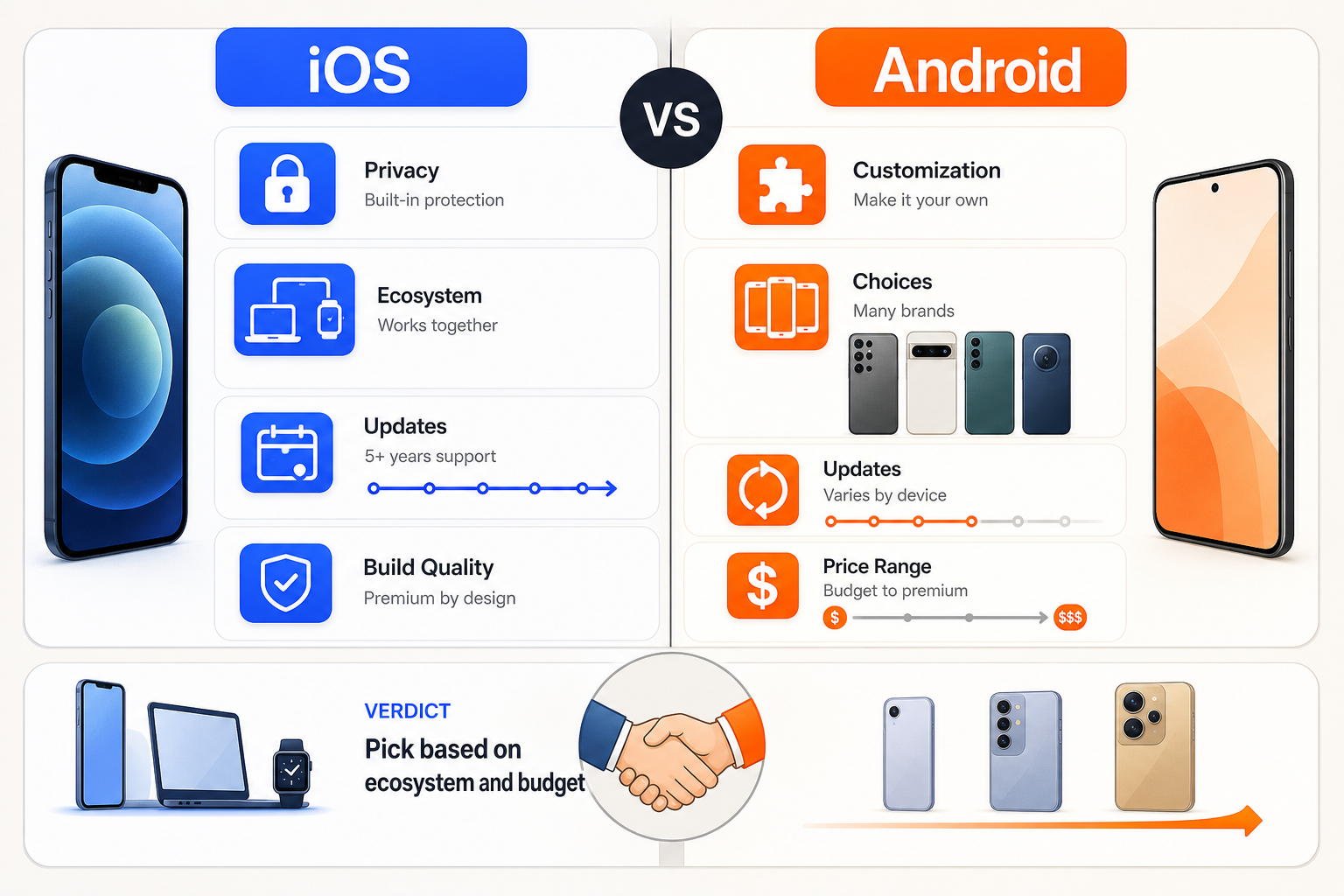
| Factor | iOS | Android | Winner |
|---|---|---|---|
| Long-term support | 5–8 years | 1–4 years (varies) | iOS |
| Affordability | Expensive | Cheap to expensive | Android |
| Customization | Limited | Extensive | Android |
| Ecosystem integration | Seamless (Apple products) | Decent (Google services) | Depends on your setup |
| Privacy | Built-in, enforced | Varies, requires configuration | iOS |
| Update speed | All devices simultaneously | Manufacturer-dependent | iOS |
The real answer: Neither is objectively better. Pick based on your ecosystem, budget, and preferences.
Budget Tiers: What You Actually Get
Here’s what your real money gets you at each price point.
Tier 1: Under $300
Best for: Tight budgets, students, frequent upgraders, “just basics” users.
Reality: Slower processor (handles normal use fine but struggles with heavy apps), mid-range camera, smaller battery (charges daily), shorter updates (1–3 years). Everything works, just with occasional lag.
Top picks:
- iPhone SE ($429, sometimes discounted)-oldest design but A15 processor (fast), 5–6 years updates
- Motorola Moto G Power 2025 ($199)-best battery, clean Android, 2 years updates
- Samsung Galaxy A15 ($149)-AMOLED screen (gorgeous), 2 years updates
Real talk: This tier is genuinely capable. Battery life varies; prioritize it if it matters.
Tier 2: $300–$600
Best for: Most first-timers. This is the sweet spot.
Reality: Fast processor (noticeably snappier), bright high-res screen (90Hz+), excellent camera, full-day battery, 3–4 years guaranteed updates. Zero compromises.
Top picks:
- iPhone 15 ($799, often discounted)-fastest processor, all-day battery, 5+ years updates
- Google Pixel 8a ($499)-best camera software, clean Android, 3 years updates
- Samsung Galaxy S24 ($799, often discounted)-gorgeous screen, 4 years updates
- OnePlus 12 ($799, often discounted)-best battery, fast processor, 4 years updates
Real talk: Everything feels fast. Photography is excellent. Battery gets through a full day. This is where the magic happens.
Tier 3: $600–$900
Best for: Serious photographers, people keeping phones 4+ years, power users.
Reality: Flagship processor (overkill for normal use), premium screen, professional cameras (zoom, low-light), 2+ day battery, 4–5+ years updates.
Top picks:
- iPhone 15 Pro ($999)-fastest processor, pro camera controls, 5–6 years updates
- Google Pixel 8 Pro ($999, often discounted)-best zoom and computational photography, 7 years security updates
- Samsung Galaxy S24 Ultra ($1,299, discounted)-zoom telephoto, stylus, brightest screen
Real talk: You’re paying for camera improvements and zoom. Processing power is overkill. Worth it if you shoot lots of photos.
Tier 4: $900+
Best for: Professionals, maximum features, newest flagship.
Reality: Everything from Tier 3 plus larger screens (6.7″+), advanced zoom (5x, 10x optical), storage options (1TB), premium design.
Real talk: Diminishing returns. Tier 3 is nearly as good. Buy here if you genuinely need the zoom or want maximum future-proofing.
Decision Framework: Your Three-Step Process
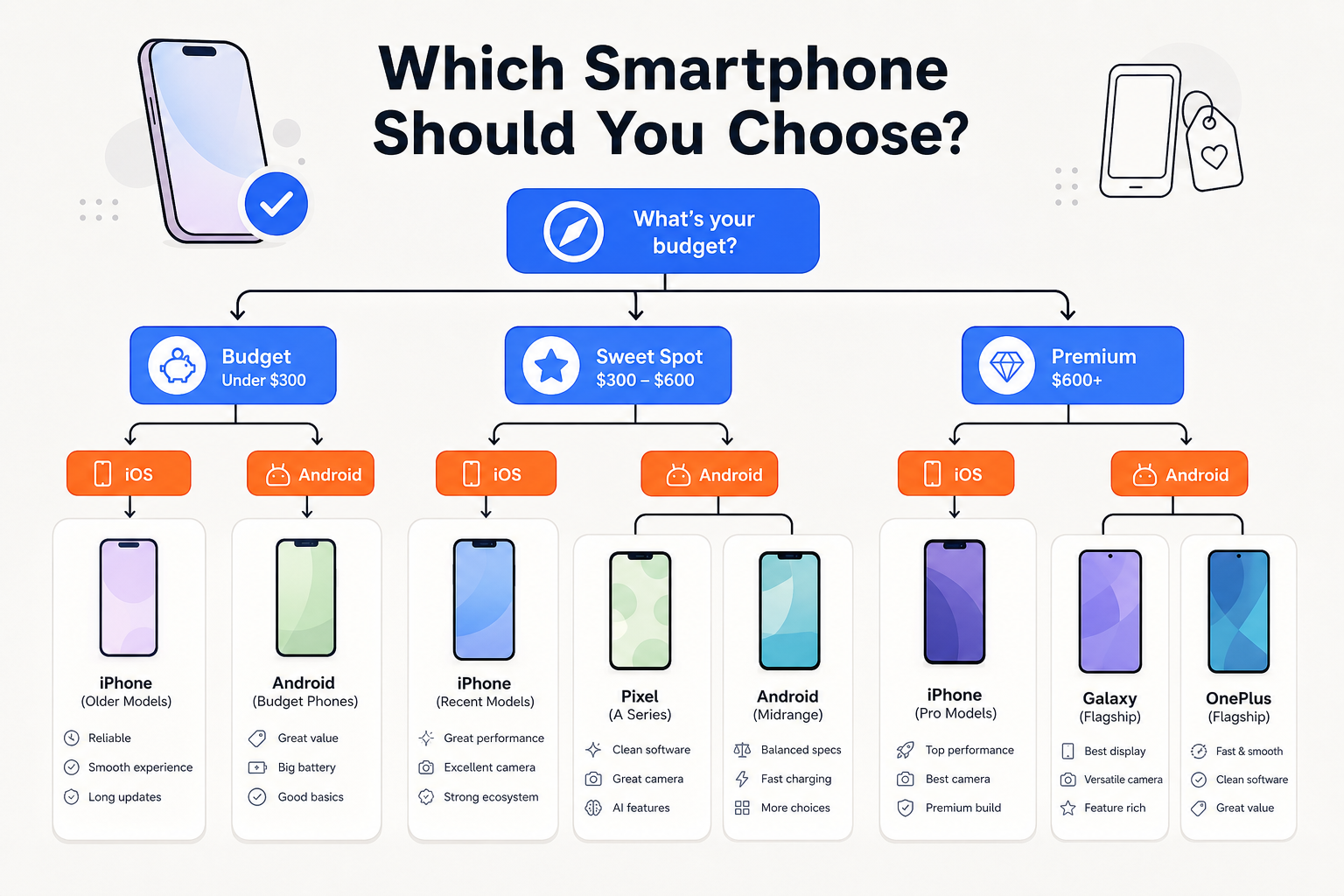
Step 1: Pick Your Operating System
- iOS? Go to Apple.com, pick iPhone 15 or iPhone 15 Pro
- Android? Pick your brand: Google Pixel (best cameras), Samsung (largest brand), OnePlus (best battery), Motorola (affordable)
Step 2: Pick Your Budget Tier
- Under $300: Motorola, Samsung Galaxy A, iPhone SE
- $300–$600: iPhone 15, Pixel 8a, Galaxy S24, OnePlus 12
- $600–$900: iPhone 15 Pro, Pixel 8 Pro, Galaxy S24 Ultra
- $900+: All are excellent; pick your preference
Step 3: Check Real Reviews
Watch video reviews from The Verge, MKBHD, or Android Authority. Check r/iPhone or r/Android for real user experiences.
Look for:
- Real-world battery life (does it last 24 hours?)
- Camera quality in different lighting
- Any quirks or issues
- How the processor feels in daily apps
Then buy with confidence.
What “Specs” Actually Mean
When shopping, you’ll see specs that sound important but aren’t. Here’s which ones matter.
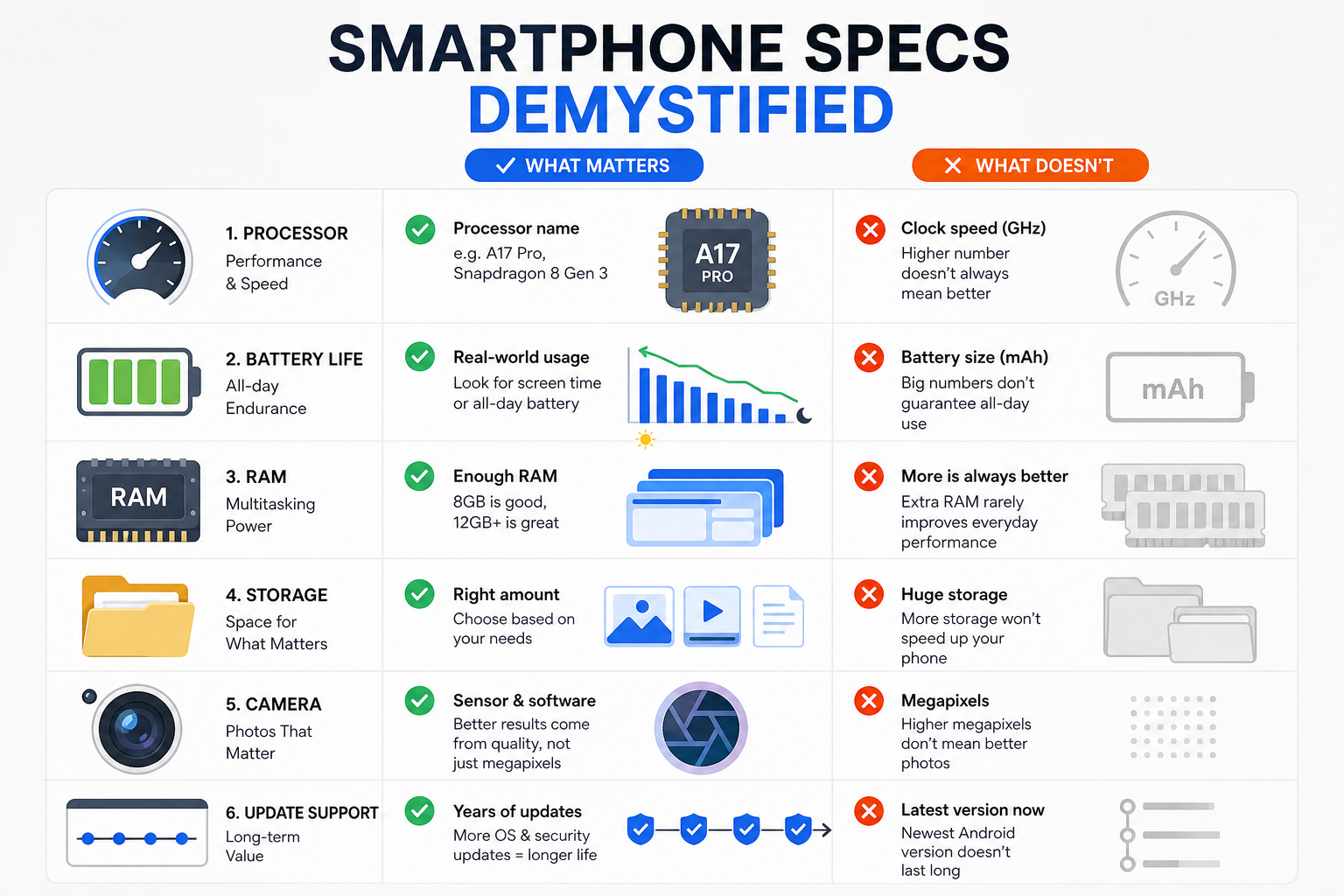
Specs That Matter
Processor: How fast apps launch and multitask. Apple A17 Pro is fastest; Snapdragon 8 Gen 3 is nearly tied; Google Tensor 3 is optimized for AI/photography. Budget chips (MediaTek, older Snapdragon) are noticeably slower.
Real-world battery: Look at reviewer battery tests, not mAh numbers. Does it last 15 hours or 24 hours? This matters more than anything.
RAM: 6GB minimum, 8GB comfortable, 12GB+ overkill. More doesn’t make your phone faster; it just keeps more apps open.
Update support: How many years you’ll get security updates. Critical if keeping 3+ years. iPhone: 5–8 years. Google Pixel: 3–5 years. Samsung: 3–4 years. Budget brands: 1–2 years.
Camera samples: Look at actual photos, not megapixels. That’s the real test.
Specs That Don’t Matter
Processor GHz: A 2.8GHz processor from 2024 beats a 3.5GHz from 2020. Ignore this number.
Megapixels: A 48MP camera with a tiny sensor loses to a 12MP with a large sensor. Look at sensor size and real photos.
RAM above 8GB: All gets you is marginally faster app-switching. Not necessary.
Refresh rate above 90Hz: 120Hz+ uses more battery without improving everyday use.
Red Flags: What to Avoid
- Ultra-budget phones from unknown brands (no support, 1-year updates)
- Previous-generation flagships at inflated prices
- Phones with less than 2 years guaranteed updates
- Phones with less than 4,000mAh batteries
- Carrier-locked phones (check unlock policy)
- Sketchy third-party sellers (no warranty, possible counterfeits)
Final Take: Stop Overthinking This
Pick between iOS and Android. Decide how much you’re comfortable spending. Buy the best phone you can afford in that range. Stop worrying. You’ll be happy with almost any recent phone from a legitimate manufacturer. The differences between $400 and $700 phones are real but marginal in daily use. The difference between good and bad phones is brand reputation and update support.
Pick your OS based on your ecosystem. Pick your budget based on what you can afford without guilt. Check real reviews for your final choice. Then enjoy your new phone-you’ve made a good decision.
Frequently Asked Questions
How much should I spend on my first smartphone?
For most first-time buyers, $300–$600 is the sweet spot. You’ll get a fast processor, good camera, all-day battery, and guaranteed support for several years. Under $300 works if you’re on a tight budget (phones are genuinely capable). Over $600 brings diminishing returns—you’re paying for zoom, larger screens, and flagship features you may not need. Pick the highest price within your comfortable range; spending $100 more at this level noticeably improves your experience.
iOS or Android—which should I pick as a first-timer?
Both are excellent. Choose iOS if you own (or plan to own) a Mac, iPad, or Apple Watch—the ecosystem integration is seamless. Apple also guarantees 5–8 years of updates, which matters if you’re keeping the phone long-term. Choose Android if you’re on a tight budget, love customization, or heavily use Google services (Gmail, Drive, Photos, YouTube). The real answer: pick based on your ecosystem and budget, not on features. You won’t regret either choice.
What specs actually matter—processor, RAM, megapixels?
Only three specs genuinely matter: processor speed (how fast apps launch and multitask—check reviews, not GHz), battery life (real-world hours from reviewers, not mAh), and update support (how many years you’ll get security updates). Camera megapixels are marketing noise—a 48MP camera with a small sensor is worse than a 12MP with a large sensor. Check real photo samples, not specs. RAM above 8GB is overkill for normal use.
Should I buy new, refurbished, or wait for sales?
Buy new from a carrier or retailer if this is your first phone—you get a warranty and support. Refurbished is fine if you’re budget-conscious; most come certified and with a 1-year warranty. Wait for sales (Black Friday, back-to-school) for 10–20% discounts on previous-year flagship models. Never buy from sketchy sellers or buy without a return policy, no matter how cheap.
How long will my phone last before I need to upgrade?
With proper care, 3–5 years is realistic. A phone under $300 stays functional but feels slower after 2–3 years. A phone in the $400–$600 range feels great for 3–4 years. Premium phones ($700+) can feel good for 5+ years. The real limiter is software support—once a phone stops receiving security updates, it’s increasingly risky to use online. Always check the manufacturer’s update policy before buying.